
Design reference: this page is not presented as a completed Benson Display client project. Use the layout and fixture ideas to describe your own requirements; specifications and project scope need separate confirmation.
Museum display cases are freestanding, tactile structures that require specialized lighting systems to ensure both artifact preservation and visitor engagement. Compliance with engineering safety standards is paramount, particularly regarding voltage regulation and thermal management. Benson Display, a leader in museum showcase manufacturing, adheres to stringent national guidelines to guarantee safety and functionality. Key specifications include the implementation of protective or isolating barriers between lighting fixtures and display spaces, ensuring secure yet accessible maintenance. For non-isolated track lighting, Safety Extra-Low Voltage (SELV) inputs are mandated to mitigate electrical hazards. Additionally, surface temperatures of fixtures must remain below 45°C during operation to prevent heat damage to sensitive artifacts.
Ease of installation and maintenance is equally critical, as frequent case openings risk artifact exposure. Benson Display prioritizes modular designs that simplify fixture replacement or adjustments without compromising structural integrity. By integrating low-voltage systems and thermal controls, the company ensures compliance with preservation requirements while addressing operational efficiency. These measures reflect a holistic approach to balancing safety, conservation, and practicality in museum environments.
Types of Display Case Lighting Techniques
Effective lighting design for museum displays hinges on a nuanced understanding of illumination techniques. Benson Display employs four primary methodologies: diffused lighting, wall washing, uniform projection, and accent lighting. Each technique serves distinct aesthetic and functional purposes. Diffused lighting minimizes shadows for uniform visibility, while wall washing emphasizes spatial depth. Uniform projection ensures consistent coverage for flat exhibits, with light uniformity ratios maintained at ≤0.8. Accent lighting, by contrast, creates focal points through controlled contrast ratios (1:3 to 1:5) between artifacts and their backgrounds.
Technical precision underpins these strategies. Adjustable brightness (0–100% flicker-free dimming), anti-glare configurations (Unified Glare Rating <19), and calculated projection angles (30°–45°) are essential for artifact protection and viewer comfort. Fixture placement follows a 1:3 horizontal distance ratio relative to exhibits, optimizing illumination without physical interference. Furthermore, modular LED systems and interchangeable lenses allow museums to adapt lighting effects dynamically, catering to diverse exhibit sizes and themes. This flexibility, combined with energy-efficient designs, underscores Benson Display’s commitment to sustainable, adaptable solutions.
Case Studies: Lighting Applications in Practice
Benson Display’s innovative lighting systems are exemplified in their freestanding, table, and wall display solutions. For instance, Freestanding Display A incorporates five interchangeable lens options paired with zoom functionality, enabling rapid adjustments to beam angles and mounting configurations (recessed, magnetic, or track-based). This versatility eliminates the need for full fixture replacements, reducing costs and environmental impact. Similarly, Freestanding Display B integrates ultra-compact track lighting with eight beam angles (6°–54°), six of which are user-adjustable, ensuring precise alignment with exhibit dimensions.
Table and wall displays further demonstrate Benson Display’s engineering prowess. Table displays feature extruded aluminum fixtures with adjustable heights and anti-glare optics, supporting modular LED arrays for seamless dimming. Wall displays, such as Wall Display A, utilize SUBROSA anti-glare technology and adjustable optical foci to enhance exhibit legibility. Linear wall-washing fixtures deliver consistent illumination across varied case lengths, while magnetic or track-mounted accent lights enable quick reconfigurations. These examples highlight Benson Display’s ability to merge technical precision with aesthetic adaptability.
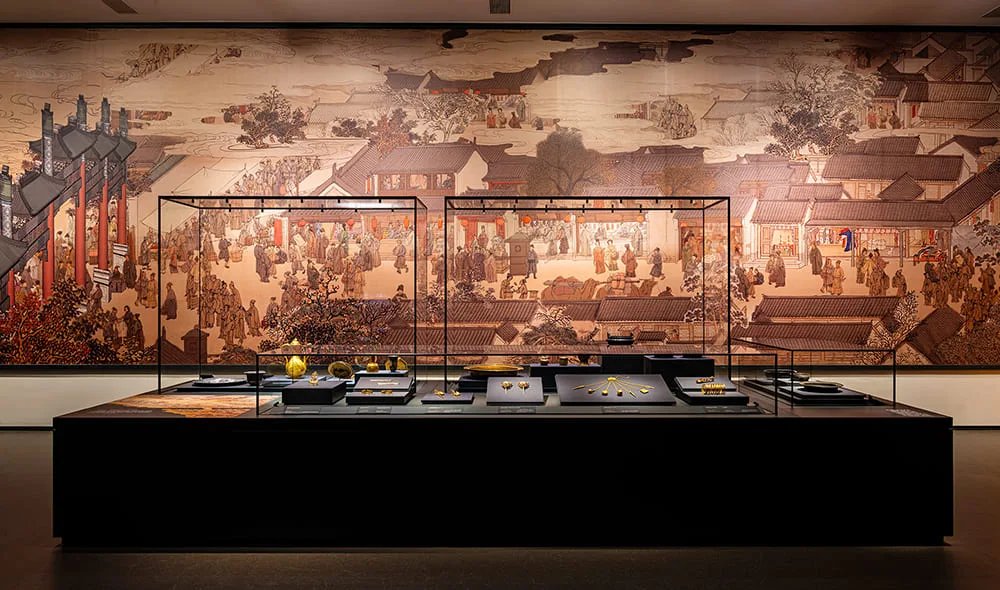
Strategies for Optimal Lighting Design
Achieving ideal lighting requires collaboration among architects, exhibition designers, and lighting specialists. Benson Display’s technical team emphasizes a holistic approach, combining accent and background lighting to balance visual hierarchy and conservation needs. For instance, a blend of uniform wall-washing and accent lighting is favored for its ability to highlight key artifacts while minimizing light-induced degradation. This method, though cost-intensive, ensures superior visual comfort and reduced viewer fatigue through controlled brightness gradients.
Spatial considerations are equally vital. Three-dimensional exhibits should occupy no more than three-quarters of a case’s internal height, with a minimum clearance of half the case height between artifacts and walls. Vertically oriented items demand display depths equivalent to one-third of their height to prevent overcrowding. Such guidelines, paired with advanced simulation tools, enable precise light distribution tailored to each exhibit’s unique requirements.
Benson Display: Expertise in Museum Lighting Innovation
As a foremost museum showcase manufacturer, Benson Display specializes in overcoming the complexities of display case lighting. Their expertise spans decades of collaboration with global museums, galleries, and exposition teams, yielding solutions that harmonize conservation, aesthetics, and functionality. The company’s patented technologies—such as SUBROSA anti-glare systems and SELV-compliant fixtures—reflect a dedication to cutting-edge innovation.
Benson Display’s portfolio showcases adaptability across diverse exhibit formats, from compact track lighting to modular LED arrays. By prioritizing partnerships with cultural institutions, the company remains attuned to evolving industry demands, offering scalable solutions for both permanent installations and temporary exhibitions. This client-centric approach, combined with rigorous adherence to international preservation standards, positions Benson Display as an indispensable partner in achieving transformative exhibition design outcomes.
In conclusion, Benson Display’s integration of engineering rigor, artistic sensitivity, and sustainable practices establishes a benchmark for professional museum lighting design, ensuring artifacts are preserved and presented with unparalleled clarity.